《Bone And Amber: The Inside Story On The Return Of The Dinosaurs》2 - A Modern Prometheus?
Advertisement
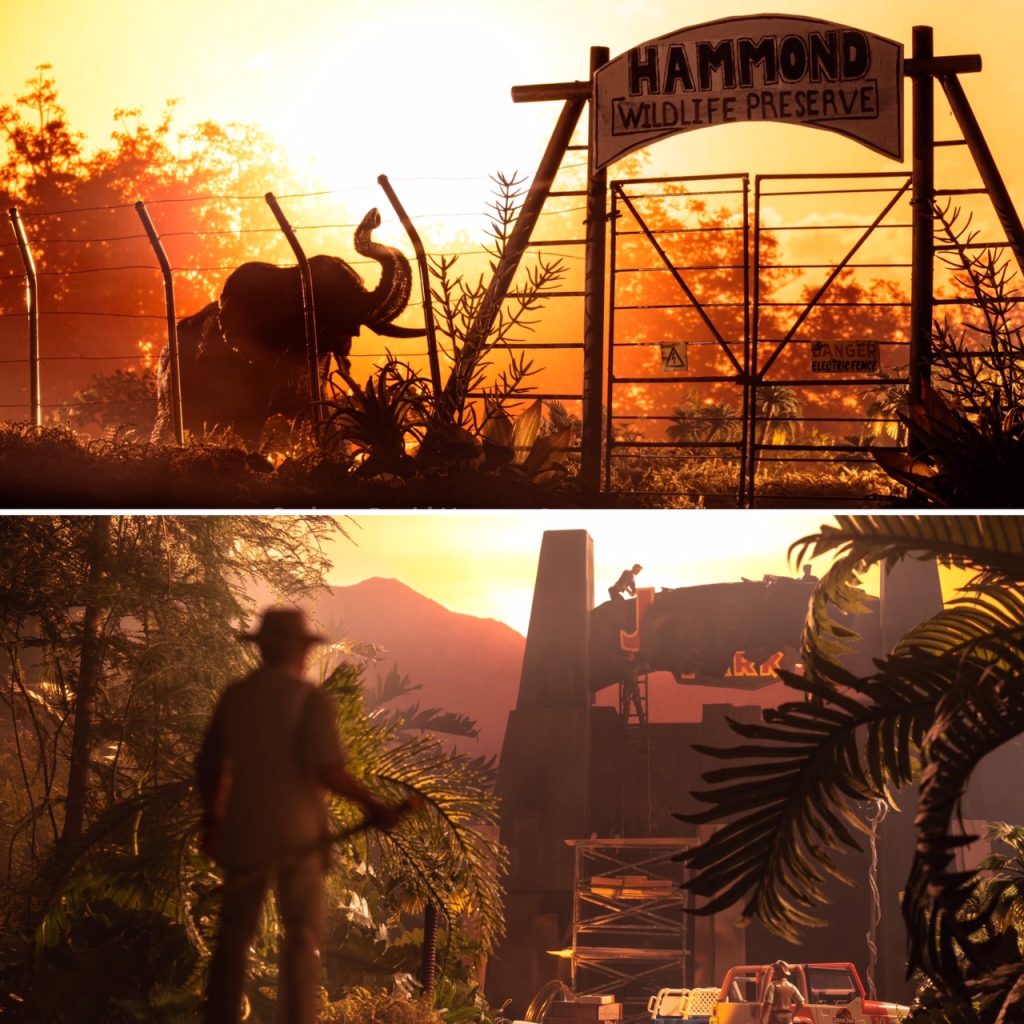
Images included as part of a pitch for a “Hammond” prequel TV show, by a team of independent writers.
Before InGen, there was John Hammond.
Few captains of industry in the contemporary era embody the Great Man theory of history the way John Hammond has: only Silicon Valley tech giants can compare. Both to his detractors and to his supporters, Hammond represents something of an avatar: the unbridled greed, or unfettered triumph, of modern capitalism, respectively. In the middle are a variety of opinions and takes at cross-purposes. To name but one, environmental activists of all stripes cannot reach consensus over whether dinosaur de-extinction in itself was good or bad. (1)
To this day, near-on a decade after his death, Hammond and his contributions to de-extinction remain an endless source of disagreements. His opponents portray him as the arch-capitalist, so driven by greed as to have monetised even life itself, all the while trampling over human rights, animal welfare, and employee safety to get his way. (2) The official biographies present him as something of a jovial visionary, with a child’s wonderment for the animals he brought back to life, and a desire to share them with the entire world; but also a reflective figure, cognisant of his mistakes and the responsibilities he bears. (3)
There is some truth to both accounts. But to unpack this complexity, we need to start at the beginning.
John Hammond was born in Scotland in 1913, at a time when the world was about to enter a different sort of upheaval. His family dabbled in finance and had achieved a measure of wealth, but his father’s real passion was for entertainment, a rising industry at the time: flea circuses, movie theatres, public attractions and theme parks were all part of young John’s experience.
Theme parks were surely a constant in the first decades of Hammond’s life. A childhood visit to the then-recent San Diego Zoo might have left a lingering impact on his psyche. In the last official biography published before his death, Hammond is reported as citing that holiday as “the last happy time” of his childhood, before the Great Depression wiped most of his family’s wealth away.
Young Hammond spent the Second World War as a BBC radio spokesman (4), and thereafter decided to move across the Atlantic. In the United States, he gave up his brief journalistic career to make a living as a performer: he opened Petticoat Lane, an automated flea circus which gave him a measure of popularity, as well as financial security.
From such humble beginnings came the de-extinction of Mesozoic dinosaurs.
Other global events in the two first post-war decades doubtlessly left a mark on Hammond. Two frequently cited events (and rightly so) are the grand openings of Disney World (1955) and Seaworld (1964). Hammond himself has frequently referenced these two specific events as a source of inspiration for InGen’s own parks. Their impact on popular culture certainly can’t be denied: it marked the coronation of theme parks as a glitzy, if peculiar, component of mass entertainment.
Advertisement
But Petticoat Lane is a much better prism to understand the enigmatic figure that is John Hammond. An automated flea circus has a considerable upside, of course: it eschews the abuse and torture of actual fleas in order to function (5).
But to Hammond, his own creation represented a source of continual dissatisfaction. Yes, it was profitable. Yes, it gave him the safety margins to invest money back into the stock market, slowly rebuilding the Hammond family wealth. But it was also an illusion, and whatever else motivated Hammond during the “flea years”, a part of his drive was certainly the ambition to stun the world with something real, something one could – in his own words – “see and touch.”
That fire, that drive inside him, would lead him and the people around him to commit both miracles and horrors.
But how does a flea circus performer end up owning a bioengineering corporation, let alone bringing dinosaurs back to life?
The first, truly transformative step along this dizzying road was Animal Kingdom, an animal preserve and petting zoo in Nairobi, Kenya. Clearly inspired by his awe at San Diego Zoo, the preserve was established in 1969, and is still open to this day – although it is the subject of constant protests from animal rights’ activists.
The protests are not due to the conditions of the African animals located therein, which live in comfort and under what is, by all accounts, a good standard of care. However, when Hammond’s interests deviated from present-day wildlife to genetic engineering of the same, Animal Kingdom was to provide him with his first test subject.
Hammond’s first contact with genetic engineering came through Norman Atherton, a Stanford geneticist who visited Animal Kingdom in 1974, and had the opportunity to tell John Hammond about his line of work.
To this day, controversy surrounds these first meetings between the two men. Did Atherton smell an opportunity, or was he genuinely convinced that genetic engineering was going to be mankind’s new frontier, unleashing limitless potential that would change the world forever? Whatever his motives, he regaled Hammond with tall tales and impossible promises, boasting that “mastery over the atom” would be topped by “mastery over genes, over life itself”.
After a year of frantic correspondence, Hammond visited Atherton in his office on repeated occasions. As the year 1975 progressed, the two hammered out the details of a business deal, which would see them co-found International Genetics, Inc. Or as it’s become known since then, InGen. (6)
Their business plan was vague, and in all likelihood would have ended in complete disaster, were it not for later events. Atherton had dazzled Hammond, and the two planned to use genetic engineering – a field still very much in its infancy at the time – to create what they referred to as “consumer-biologicals”.
This vague idea seemed to mean completely different things depending on which mood happened to strike Hammond: genetically engineered exotic pets, or perhaps peculiar beasts of burden, or maybe fierce but dependable animals to be deployed in conflict theatres. The focus on animals as the “product” was already much in evidence.
Advertisement
Regardless of what InGen was supposed to be making, it needed an early investment if it wanted to set up shop properly. Hammond may have been taken away by Atherton’s promises, but he was no fool, and refused to commit more than absolutely necessary financial resources in the opening phase of the project. What he needed from Atherton was a pitch: a demonstration of the power that genetic engineering could unleash, if InGen could count on reliable, long-term investments.
And Atherton delivered.
Using genetic material from one of the elephants housed at Animal Kingdom, Atherton managed to clone an elephant. This in and of itself was an exceptional result: prior to his endeavour, the number of successfully cloned elephants was zero (7). But he went further than this, at Hammond’s insistence.
The elephant was subject to a series of alterations, primarily to its endocrine system, to suppress its growth. This is a point of important note: the elephant’s genetic makeup was not actually altered. It was essentially subjected to a sophisticated process of hormone suppression, which kept the animal at a size only slightly larger than a newborn elephant’s.
The miniature elephant became Hammond’s pitch – or, as he liked to call it at the time, his Pachyderm Portfolio. He toured the United States, Western Europe, and Japan, delivering fiery speeches to would-be investors. And then, when he reached the punchline, he would pull the drapes off a small cage, revealing the miniature elephant.
The “ooohs” and “aaahs” inevitably followed, and so did the money. The miniature elephant provided InGen with barely plausible amounts of money – without a clear plan on how to invest them, or a singular goal to work towards. Through its existence, the animal guaranteed InGen’s survival.
Naturally, Hammond never mentioned the fact that the animal was a product of hormone suppression. That was far from his only lie of omission at the time.
The poor elephant was constantly sick, prone to both bacterial and viral infections, and by all accounts subject to inadequate veterinary care. It spent most of its sad existence in the cage, as its temperament was moody, and included unpredictable bursts of aggression.
Hammond lived in constant anxiety that the miniature elephant would die, a dread worsened by Atherton’s seeming inability to replicate the experiment, with a gruesome string of dead or terminated subjects dotting the late 1970s. Atherton himself, ever closer to a mental breakdown under Hammond’s pressure, later found out he had terminal cancer, with mere months to live. (8)
The elephant died in 1980, outliving his creator by mere weeks. By then, the Pachyderm Portfolio had netted Hammond a ludicrous amount of capital, but no strategy for how to use it, and no geneticist with the ability to implement any strategy.
InGen’s story would have surely ended in disaster, were it not for another seminal encounter between Hammond and a talented, unscrupulous geneticist, whose attention was caught by the increasing publicity surrounding the Pachyderm Portfolio. The man in question was Henry Wu, then only a PhD student at Oklahoma State University.
Unbeknownst to him, John Hammond had just met the man who would become the architect of the return of the dinosaurs.
Footnotes:
(1) A profoundly fascinating conundrum, in my opinion, which rests entirely on your definition of “good”. So long as dinosaurs are confined to a park, then their presence is effectively irrelevant for the purposes of the wider biosphere. On the other hand, the knowledge they would unlock would tell us so much about the nature of deep time, extinction, and climate change – it already does in OTL, when all we have is bones! Of course, should they ever get out, it would be a disaster for existing faunas. But that doesn’t automatically mean a disaster for vertebrate life in general! We’ll have lots of fun with this concept going forward.
(2) The novel’s portrait, in which he is a cartoonishly evil villain.
(3) The movie’s portrait, in which he’s your friendly, dinosaur-cloning grandparent, but with a dark side to him as well. Perhaps unsurprisingly, I chose to go with this version, as it allows for more character development – but I injected some of the book’s darkness back in, to deliver what I feel is a more realistic portrait of a ruthless venture capitalist who also happens to be a nerd.
(4) My invention. His early life isn’t covered in any big detail by the franchise.
(5) No, seriously, look it up. It’s fairly horrific.
(6) The franchise itself is all over the place when it comes to these dates. I’ve picked a date sufficiently early that it doesn’t require an improbably fast progression to get to the dinosaur cloning.
(7) And in OTL, it is zero to this very day. Which is a healthy reality check to keep in mind when we read the press releases about an attempt to bring mammooths back to life. The attempt is real enough, but it faces steeper odds than they’d like to admit.
(8) The Pachyderm Portfolio is lifted from the original novel. It is the one good, dark part about Hammond’s backstory I think is written compellingly enough to include in this work.
Advertisement
- In Serial570 Chapters

Tsuki ga Michibiku Isekai Douchuu
High school student Misumi Makoto is called into a fantasy world by the god Tsukuyomi, in order to be a hero. However, the Goddess ruling the world isn’t as thrilled to have him there, and kicks him to the edge of the world. Tsukuyomi declares that Makoto is free to find his own way after Makoto is abandoned by the other Goddess.
8 232 - In Serial11 Chapters
From NPC to villain
This story is told on behalf of the characters who live in the game. The storyline tells the story of Alme, a girl working in the guild.
8 333 - In Serial41 Chapters
In the Dark of Night
Sixteen years ago, the royal family was slain in cold blood. The entire country of Radëgon was plunged into an age of chaos. Monsters and Beasts that feasted on humans and Fae alike awoke from deep slumbers. Yet one type of creature remained dormant, barely even spoken of in Selene's home village. Demons. She believed them to be tales until one attacks her home and slaughters everyone. Escaping into the nearby forest with only a surviving child and a horse, Selene has to face the terrors of the world on her own. A power is awoken within Selene during an encounter with a beautiful demon who tells her someone is behind all the misery she has ever felt. With the help of a man who seems to know more about her power than he says, she sets out to find the being who took away the only things she ever loved. Little does she know, she's the one he wants."She had heard stories of entire towns vanishing in one night. Rumors of demons being their cause spread through the country, striking fear in the hearts of peasants and all those who were helpless to the will of the Realm of the Dead. Yet no one ever believed them, demons were myths. Even if they weren't, they hadn't woken up on the day the world fell to chaos.Selene gripped the rusted nail in her hands tighter, her palms slick with sweat. She saw the monster's shadow under the door as it inspected it. Then, it swung open.Fear unlike anything Selene had ever know filled her as she beheld what had mutilated Gwendolyn.The demon stepped into the room."
8 301 - In Serial20 Chapters
Claws and Lightning (Male Zeraora Reader x Boku no Hero Academia)
(Y/N) Zeraora. Born with traits and characteristics of a tiger and electrokinetic powers. His origins are unknown, found by the Wild Wild Pussy Cats at a young age and soon taken in by them. Years pass and he eventually turns his attention to the path of heroism. A path that would soon help to unveil the mystery that is his origins."Keep your claws sharp but keep your senses sharper."(Y/N) ZeraoraDisclaimer: I do not own Pokemon, or My Hero Academia, this fanfic is for fun, to show my enjoyment for BNHA manga/anime, and one of my favorite pokemon. I also do not own any songs used my story. Again, all right reserved to their owners.
8 215 - In Serial3 Chapters
dvr3 group chat
gen z humor....😁
8 89 - In Serial80 Chapters
KARNA - MAHADEV'S DECIPLE
I do not want hurt anybody's religious sentiments. This story is purely my imagination, what if karna in search of his guru after rejected by several guru was taken as disciple of lord mahadev himself? what would happen in mahabharat if karna was in dharam paksh.
8 204


 Prev Chap
 Next Chap
 Chap List
 Boy
Boy Girl
Girl