《Bone And Amber: The Inside Story On The Return Of The Dinosaurs》15 - Armed And Armoured
Advertisement
15 - Armed And Armoured
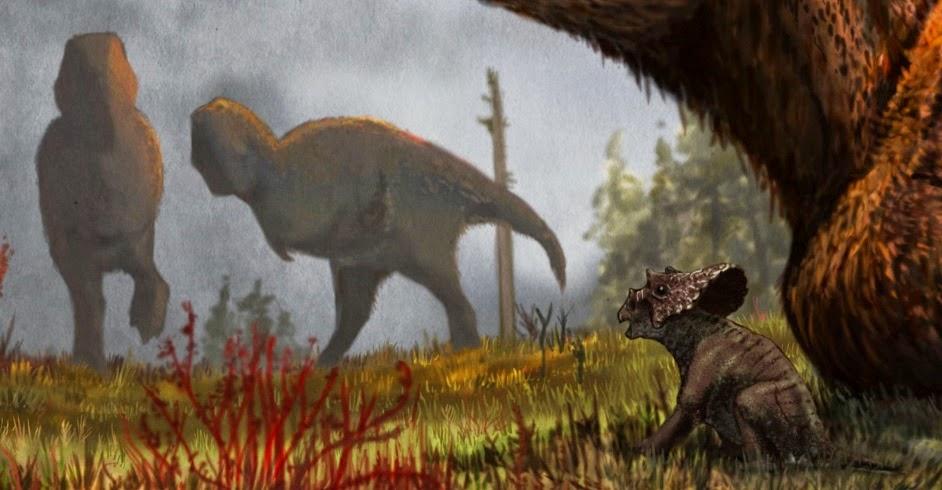
Detail of a painting by Mark Witton, showing a speculative example of Cretaceous interspecies adoption: a baby Triceratops has been adopted by a Tyrannosaurus rex. Full painting here. (1)
As part of the first wave of new arrivals on Sorna, Triceratops fit the pattern of InGen’s early cloning operations. Here was a superstar, a species almost as ubiquitous as Tyrannosaurus in popular culture - and usually depicted in mortal combat with it. Upon reaching adult size, Triceratops would surely be one of the main ticket sellers in InGen’s new park.
However, the newly cloned animal repeated the pattern in other ways. Much like the sauropods, it was critically underestimated by people with very few direct experience with wild animals.
The tiny Triceratops were simply adorable to look at. Yes, in adulthood they would grow into elephant-sized mountains of muscle and horns, but shortly after hatching, they looked like tiny quadrupedal parrots, with an adorable frill and large, round eyes.
They were also clearly gregarious. Like the sauropods, hatchlings stuck together in small age-segregated herds, not really mingling with further egg clutches as InGen produced them.
These traits, combined with inexperience, lulled several members of the staff into a false sense of security.
Triceratops were the result of a long and likely bloody evolutionary arms race with predators - the same arms race that produced Tyrannosaurus rex. Mutual evolutionary pressure favoured bigger size, and more weapons of defence and offence. Even as hatchlings, they were tough animals: they needed to be.
This inherent toughness transcended the classic predator/prey relationship. Triceratops also owed a large part of their success to their feeding adaptations. Their mouths had very limited lateral mobility: they could mostly slash up and down like a pair of scissors.
Combine this with their wrap-around overbite, their sharp beaks, and their double batteries of teeth, and you have all the ingredients of a shearing bite able to cut through even the densest forms of vegetation.
Beyond that, the frill served as the anchor for truly powerful muscles, giving Triceratops one of the strongest bites ever recorded in the history of life on Earth.
The fact that an animal that reached such tremendous sizes in adulthood, had three horns - two of which gigantic - and shielded its neck with a bony frill, would also count a powerful shearing bite in its arsenal, says everything about the inherent toughness of the Mesozoic world.
Advertisement
In the first truly serious incident since the beginning of operations, a geneticist lost a finger while manipulating a baby Triceratops. Hammond did his best to make sure the issue went away quietly, and she was fired with a huge severance package, in exchange for her silence.
At least, the incident proved instructional in a way that Muldoon’s stern warnings were not. The staff started to give a wide berth to the Triceratops hatchlings, leaving Muldoon’s staff-in-training with the question of how they would deal with numerous herds of these temperamental Ceratopsians, once they reached adult size.
While mostly herbivorous, the tiny Triceratops were more than happy to supplement their diets with the occasional protein snack: small reptiles, birds, and mammals found while browsing were fair game.
Given the large numbers in which they were cloned, their ability to shear through any vegetation, and their proclivity for chomping on small vertebrates, they would have a detrimental impact on Sorna’s environment.
But this was a trifling concern to Hammond. It was the finger-incident that dominated his mind during the following weeks. When confronted with the reality that the animals would remain small for years and decades, one of the strategies Hammond had considered for his park was to introduce an entire section that would function like a petting zoo.
This was clearly not possible. The idea of a kid being lashed in the face by an Apatosaurus’ whip-tail, or getting their hand bitten off by an angry baby Triceratops, was as anathema to InGen’s lawyers as it was to Muldoon.
It was at this time that Hammond began floating the idea of domesticating the dinosaurs. If this was done with modern-day animals, surely it would be possible with dinosaurs as well. Why should InGen raise them in a semi-wild context, as it currently was on Sorna? What if they were bred, raised, or even re-designed to seek and enjoy human companionship?
Under intense pressure from Wu and Muldoon, this discussion was eventually postponed - but never truly sidelined. It would come back to haunt InGen’s planning, again and again. For now, however, the commercial focus continued to develop in the direction initially set by Hammond.
Cloning large numbers of animals was the only way to ensure a steady supply of specimens to new parks that might be opened around the world. With the petting zoo now off the cards, the first park itself would simply have to find different ways of providing the spectacle that visitors would no doubt be seeking.
Advertisement
At around the same time that baby Triceratops began roaming their Sorna enclosure, InGen also resurrected another species of armoured herbivore from late Cretaceous North America: Ankylosaurus.
While broadly less famous with the masses, Hammond considered Ankylosaurus to be an absolute must-have for any park. The incredible anatomical features of this animal made it look like something straight out of a sci-fi story. (2)
Quadrupedal, as tall at the hip as an adult human, and reaching to nine metres in length, Ankylosaurus was built like a living tank. The entire upper portion of its body was encased in a bony, ossified layer of literal armour.
Indeed, such armour reached such extreme lengths, that its cranial portion literally fused with the skull, creating one continuum of bone. Even the animal’s eyelids were ossified.
Ankylosaurus also possessed a weapon for offence: a powerful, bony tail club, with enough strength that a swing could easily shatter the bones of any would-be opponent.
The fact that an animal of this size needed this level of armaments should, once again, stimulate reflections on the evolutionary pressure posed by predators such as Tyrannosaurus. But Hammond didn’t see the inherent danger, only the cool list of factoids that could be fed into a mighty marketing machine, and draw people from all over the world to see these animals in the flesh.
In any event, the Ankylosaurs were effectively a footnote in the early history of Sorna. Guessing (for once, correctly) that they were solitary animals, only a few specimens were cloned. This decision also stemmed from practical considerations - Ankylosaurus remains are exceedingly rare in the fossil record, leaving InGen with less genetic material to harvest. Only two individuals survived the first incubation.
Nevertheless, they proved surprising in their own right. They were essentially unarmoured after hatching, in and of itself a great discovery, confirming the hypothesis that their armour would form and solidify over years of growth - although very displeasing to Hammond, who so wished to display the two hatchlings as mini-tanks.
Devoid of armour, the baby Ankylosaurs relied primarily on hiding as a defence mechanism. Were it not for the tracker chips implanted into them, Muldoon would have had a lot of trouble accessing them in their enclosure - and even this was insufficient to entirely quell Hammond’s anxiety about the two critters being so “anti-social”.
It is likely that some of Ankylosaurus’ relatives burrowed into the earth. While adult Ankylosaurs observed since their resurrection don’t do this, their tub-shaped bodies still allow them to pursue a peculiar feeding strategy, which InGen didn’t foresee.
Sticking close to the ground (which, in adulthood, would have the added benefit of minimising the exposure of unarmoured body parts), the baby Ankylosaurs let loose on beets, roots, various kinds of tubers, and even insects. These they caught with an elongated, incredibly strong, chameleon-like tongue, which InGen was observing for only the first time.
Muldoon and his team had to resort to ever cleverer techniques to approach the babies. Unlike in adulthood, they definitely did burrow for protection, leading to exhausting and prolonged ordeals whenever they needed manipulating for any reason. But Muldoon thanked his lucky stars with these two. Compared to the other animals being reared in Sorna, the Ankylosaurs were very low-management.
And purely in terms of complexity, the worst was yet to come.
Footnotes:
(1) While unusual, such behaviour is definitely present in modern-day animals, the most famous case being Kamunyak, a lioness famous for adopting oryx calves in the wild in the early 2000s. The causes of this abnormal behaviour are unknown, and probably vary depending on the species involved. The painting is, of course, still highly speculative - particularly given the possibility that strong age segregation in Tyrannosaurs could lead to adults with little parental instincts. It’s worth reading the full blog post Mark Witton used to accompany this painting, it makes for a great read.
(2) I really like the reconstruction used for the videogame Saurian, done with help from Ankylosaur researchers to be as accurate to current scientific knowledge as possible.
Advertisement
- In Serial24 Chapters

Shipshape (Now writing book 2)
Jack had always wanted to be a Shaper, to form pure life-force into obedient beasts and monsters and lead them into battle. Unfortunately, the only way to Shape life-force is through the use of Patterns, and the knowledge of how to make Patterns was lost when the old-world fell. These days, what Patterns remain in the world are closely guarded by their owners, who charge exorbitant amounts of gold from anyone who wants to use them. It took Jack years of scavenging in the ruins of the old-world, evading deadly traps and ravenous monsters, to gather the gold needed to pay for access to a Pattern and Shape himself a pair of hunting Hounds, and take the first step into realizing his dream. Book 1 can now be found on Amazon Cover art by Amarihel Story will contain unusual/harem relationships!
8 165 - In Serial87 Chapters
Artifice: Tools of the Gods
Near a remote mountain mining village, an infant is left in a circle of blue magical flames. Villagers from the nearby mining village of Porra-Kel find this infant and see that she is a Terran, a soul reincarnated from a different world. A world called Earth. The villagers choose to raise this child, which they name Salis, as one of their own. When Salis is older and learns the language of those around her, she finds out that Terrans have a reputation. One that means those in power will desire if they find her. The power of knowledge that could change the balance of the world. P.S. Hope you like the temporary cover.
8 147 - In Serial29 Chapters
Guardians of Midgard: The Legend Begins
Synopsis: The final day of the school year could not have ended any worse for Eddie Ferguson. His world will forever be changed for the worse when he was ambushed and abducted by goblins and a powerful sorcerer that has put parts of Michigan under a hypnotic and slumber spell. Cassandra and Woden the Wanderer; a famous ancient wizard from the old ages rescues Eddie. Not too long afterwards, Eddie learns that his mother is more than just a normal widowed homemaker and that he carries within himself one of the Six Elder Dragons. Blackhaven, an evil rogue guild pursues Eddie throughout the universe of the world tree Yggdrasil. They are a faction that is tracking and hunting elder dragons. They will never stop and use any means necessary to achieve their goal. To survive, Eddie must endure hardship and many obstacles. Concepts: The book series is influenced by and based off the Naruto manga (Japanese comic) written and illustrated by Masashi Kishimoto set in an Alternate Universe set in a Norse Mythology, European Mythology and Modern Age crossover fantasy. The setting is from a crossover between Norse and European mythology. Other concepts? The series will be the third or fourth generation between tales of Orcs versus Humans, started nearly a century ago by author J.R.R. Tolkien.
8 136 - In Serial13 Chapters
Beanstalk
A story of a janitor who gave up on life and two teenagers who are petty thugs. Set in a world where humanity has only recently discovered the Earth is really a prison and they used to be Masters of the Universe. Follow the unlikely adventures of our three stooges as they travel up the beanstalk, develop incredible powers and do whatever the fuck they feel like as they go along. This is Beanstalk. Part action, part sci-fi, part cultivation, all comedy. Note: This will be updated when i have spare time. But Book 1 will be written until complete. Book 1 = 30 chapters at roughly 2k words a chapter.
8 191 - In Serial16 Chapters
Prisoners: the hidden face
For millennia, planet Earth has been a prison planet. The confederation of 116 planets once imprisoned earthlings. She is now ready to free the prisoners. But at what cost ?On an overpopulated and divided planet, a young woman tries to save her sick brother. She does not know that many trials await her
8 76 - In Serial54 Chapters
What's Really Hood
|| Chris Brown || Trinity has never been to the hood or even imagined what the hood would be like. That's until her and her father moved out to New York from the luxurious California. There, she meets a group of urban kids where she experiences crime, death, and violence. What's really hood.
8 225




 Prev Chap
 Next Chap
 Chap List
 Boy
Boy Girl
Girl